Simplifying the Shopping Cart Experience
Enhancing clarity, flexibility, and transparency for a $10B+ retailer
UX Lead
2023
Task Completion 70% → 90%
Checkout Redesign | $10B+ Retailer
TL;DR
THE problem
High cart abandonment rates revealed friction around delivery expectations, shipping options, and order flexibility.
THE Solution
Redesigned cart structure grouping items by delivery type, simplifying shipping options, and introducing flexible delivery choices.
MY ROLE
As the dedicated UX Architect, I led the redesign from research insights to final interaction design, collaborating across teams.
IMPACT
Prototype testing showed task completion increased from 70% → 90% with fewer user errors selecting shipping options.
THE CONTEXT
A complex cart experience at a $10B+ retailer
Ashley Furniture’s ecommerce cart handled a mix of fulfillment models:
Home Delivery for large furniture items
Direct Ship for smaller products shipped individually
However, the existing cart presented items as a flat list, making it difficult for customers to understand:
when items would arrive
how shipping worked across products
whether deliveries could be split
Customer feedback and analytics showed that this confusion was contributing to cart abandonment and support inquiries.
As a $10B+ retailer, even small reductions in friction could meaningfully impact revenue and customer satisfaction.
THE PROBLEM
Three sources of friction
Through user research, analytics, and collaboration with customer care and operations teams, three core issues emerged.
Lack of clarity
Products were listed individually even when they shared the same delivery method.
This made it difficult for users to understand how their order would arrive.
“I just want to know if everything’s coming together.”
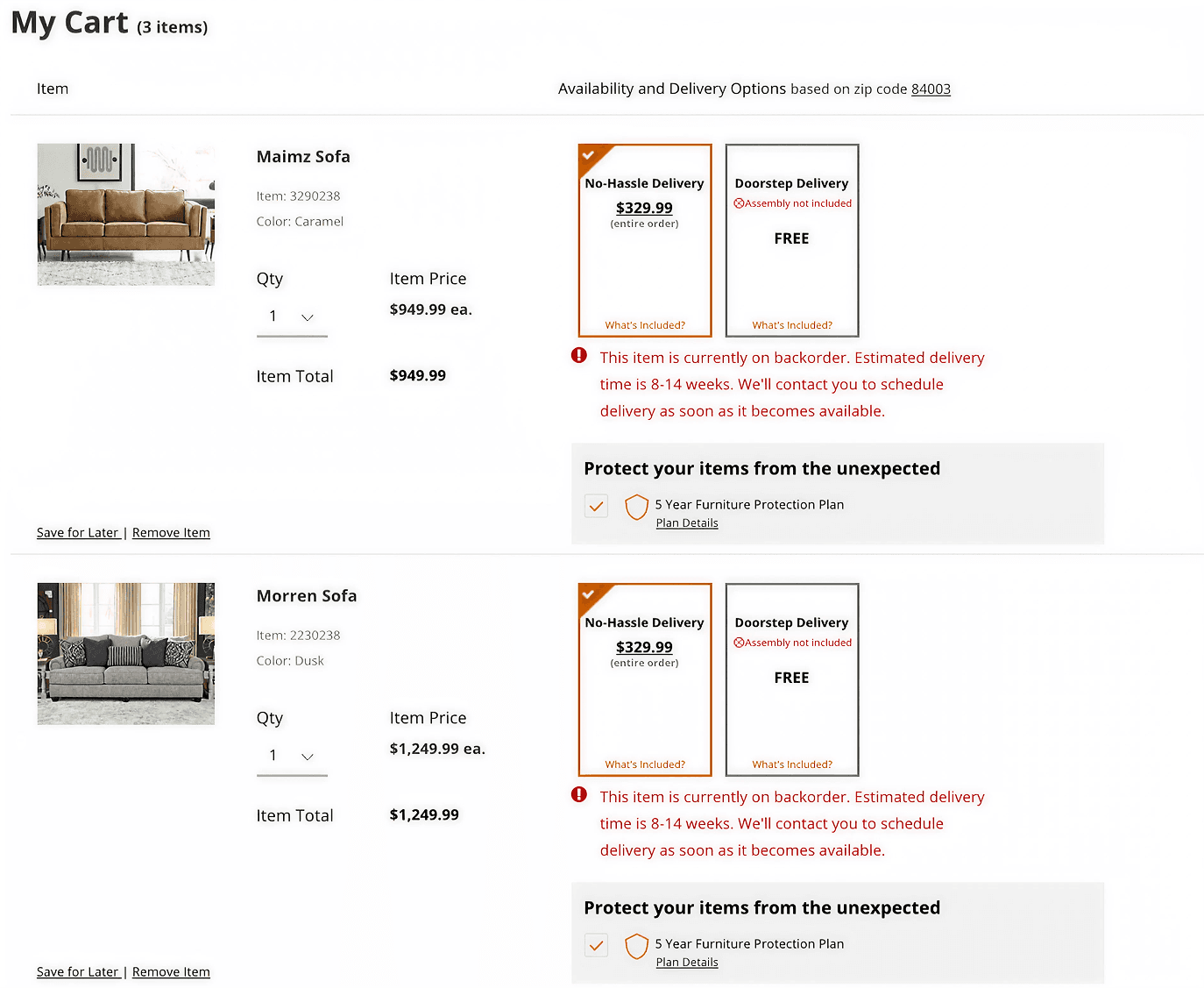
Limited flexibility
If one item had a delayed delivery date, the entire order would be delayed.
Customers had no way to split deliveries, even when they preferred receiving available items sooner.
Missing Transparency
Key details — including delivery timing and assembly requirements — were only surfaced later in checkout, increasing uncertainty and hesitation.
THE APPROACH
Simplifying the cart without breaking fulfillment logic
The challenge wasn’t just improving the interface — it was designing a solution that worked within Ashley’s existing fulfillment systems.
Working with product and operations teams, we identified three guiding principles for the redesign.
Simple
Group items by delivery type to reduce cognitive load.
Flexibile
Allow customers to choose between consolidated or split deliveries.
Transparent
Surface delivery timing and assembly information directly in the cart.
DESIGN PROCESS
Testing and iterating on delivery clarity
I developed user flows, wireframes, and interactive prototypes to explore potential solutions.
Working with the UX Research team, we ran multiple rounds of usability testing.
ROUND 1
Users struggled to understand mixed delivery types within a single order.
ITERATION
Added delivery group headers and consolidated shipping options.
ROUND 2
Users identified groupings and completed selections with confidence.
FINAL PROTOTYPE
90%
of users completed shipping selections successfully — no errors.
THE SOLUTION
A cart built around delivery clarity
The redesigned cart introduced structural changes that improved both usability and flexibility.
Grouped cart layout
Products were organized by delivery type (Home Delivery vs. Direct Ship), making fulfillment expectations immediately clear.
Simplified shipping options
Identical shipping options were consolidated within each delivery group to reduce redundancy and prevent inconsistent selections.
Delivery flexibility widget
Customers could toggle between:
Consolidated delivery (ship everything together)
Split delivery (receive available items sooner)
This gave customers control while still aligning with fulfillment capabilities.
Enhanced delivery transparency
Delivery dates and assembly indicators were surfaced directly within the cart, helping users make informed decisions earlier in the purchase journey.
IMPACT
Improving confidence before checkout
Usability testing demonstrated meaningful improvements in the redesigned experience.
Key outcomes included:
Task completion increased from 70% → 90%
Fewer user errors when selecting shipping options
Improved clarity around delivery timing and fulfillment
These improvements helped reduce cart abandonment and support inquiries, creating a measurable business impact for a $10B+ retailer.
REFLECTION
Designing for both users and operations
This project reinforced how ecommerce checkout experiences sit at the intersection of user experience and operational constraints.
Improving the cart required balancing:
customer clarity
fulfillment complexity
engineering feasibility
Leading the redesign from concept to launch allowed me to deliver a solution that worked for both users and operational systems.
Small structural changes — like grouping products by delivery type — can significantly improve user understanding without requiring major system changes.
UX Architecture
Ecommerce
Checkout Optimization
User Research
Cross Functional Collaboration